

How The Best Third Works
Retirement income is a fundamentally different problem from retirement saving. Saving tools are built to optimize for growth; spending requires a different discipline — knowing how much to draw each year, calibrated to your actual portfolio, your Social Security timing, your tax situation, and markets that change year by year.
The Best Third addresses this through the Annually Recalculated Virtual Annuity (ARVA) framework, which provides two interlocking components: Secure Base Income — funded through TIPS and Social Security and other reliable income sources — and variable Bonus Income from an equity portfolio that adjusts each year to what the portfolio can genuinely support.
The sections below explain why conventional withdrawal rules fall short, then describe how each component works and how the platform brings them together into a personalized retirement income plan.
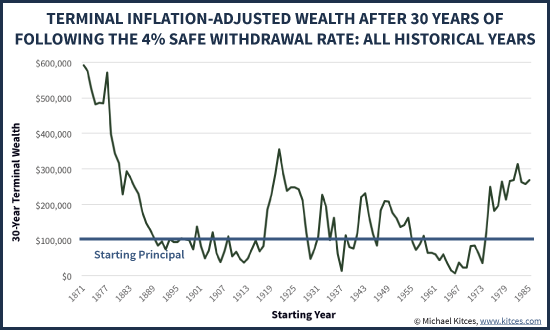
Source: Michael Kitces at Nerd’s Eye View
The Problems With Conventional Withdrawal Rules
The 4% rule was designed as a planning benchmark, not a spending strategy. It was derived from historical data to estimate the maximum withdrawal rate that would have survived the worst 30-year retirement scenarios on record — useful as a rough starting point, but too blunt for actual use.
The rule presents two problems. If future markets are worse than anything in the historical record, it offers no guarantee of portfolio survival. More commonly, the rule is so conservative that when markets perform better than the historical worst case, a fixed 4% strategy leads retirees to spend less than they could genuinely afford, accumulating a larger estate than they intended while shortchanging the retirement they worked for.
The rule also ignores that spending in retirement is not constant. Research shows that retirees tend to spend the most in their 60s and early 70s and reduce spending as they age. A constant withdrawal rate may cause a retiree to hold back in their most active years to preserve a portfolio they won’t ultimately need at the same level, while also failing to account for Social Security timing and tax rates. A credible retirement income framework has to account for all of this, and recalibrate as circumstances change.
The ARVA Framework
The principle is straightforward: The TIPS ladder provides Secure Base Income which you can count on. With the equity layer, your Bonus Income is recalculated every year based on what your portfolio can support given its current value and your remaining time horizon. Because your Bonus Income adjusts to your actual portfolio every year, the withdrawal responds automatically to changing market conditions. If markets decline, Bonus Income falls. If markets perform well, Bonus Income rise and you can spend more. There is no fixed dollar withdrawal forcing you to hold back in good years or draw down in bad ones.
You choose how much income you want to secure. That choice determines how much of your portfolio is needed for the TIPS ladder, with the remaining assets available for equities. The tradeoff is straightforward:
- More TIPS, less equity: spending is more stable and predictable. Your essential income level is secure regardless of what markets do.
- More equity, less TIPS: spending is higher in good markets, lower in bad ones — more variability, but greater potential upside.
Historically, greater equity exposure has generally supported more total spending, but with greater variability. Secure Base Income lets you decide how much of that variability you are willing to accept.
The Best Third also lets you configure cash flows to reflect anticipated changes in spending and tax liabilities over time. Spending in your 70s often looks different from spending in your 90s, and tax rates may shift as your income sources evolve. The two sections below explain how each component works within this framework.

The TIPS Ladder
The Best Third uses a TIPS ladder to establish a foundation for Secure Base Income.
Treasury Inflation-Protected Securities (TIPS) are U.S. government bonds whose principal adjusts with inflation. The Best Third builds a ladder of individual TIPS bonds held to maturity — not a TIPS fund. A TIPS fund fluctuates in value with interest rates and provides no guaranteed cash flows. A ladder of individual bonds held to maturity eliminates that uncertainty: each bond delivers known, inflation-adjusted payments at specific future dates. Staggering bonds across multiple maturity dates creates a predictable stream of inflation-adjusted cash flows year by year.
Combined with Social Security, this becomes your Secure Base Income — the portion of your retirement spending that is covered regardless of what markets do. Think of it as a reliable paycheck: essential expenses are funded, inflation-protected, and not dependent on portfolio performance. This frees the equity portion of your portfolio to do what equities do best, without the anxiety of needing it to cover the bills.
The Equity Layer
The second layer uses a low-cost equity index portfolio to fund variable Bonus Income — additional spending beyond your Secure Base Income. Rather than withdrawing a fixed amount each year, ARVA recalculates the variable Bonus Income annually based on your current portfolio value and time horizon.
Think of it as a bonus on top of your paycheck. In years when markets perform well, your Bonus Income is higher and you can spend more. In years when markets decline, it adjusts downward — but your essential expenses are already covered. You’re not forced to cut necessities; you’re adjusting discretionary spending to match what your portfolio can genuinely support.
Together, the TIPS ladder and equity layer create a retirement income structure that is both stable where it needs to be and honest about the upside available in good markets.
Using the Tool
Describe Your Situation
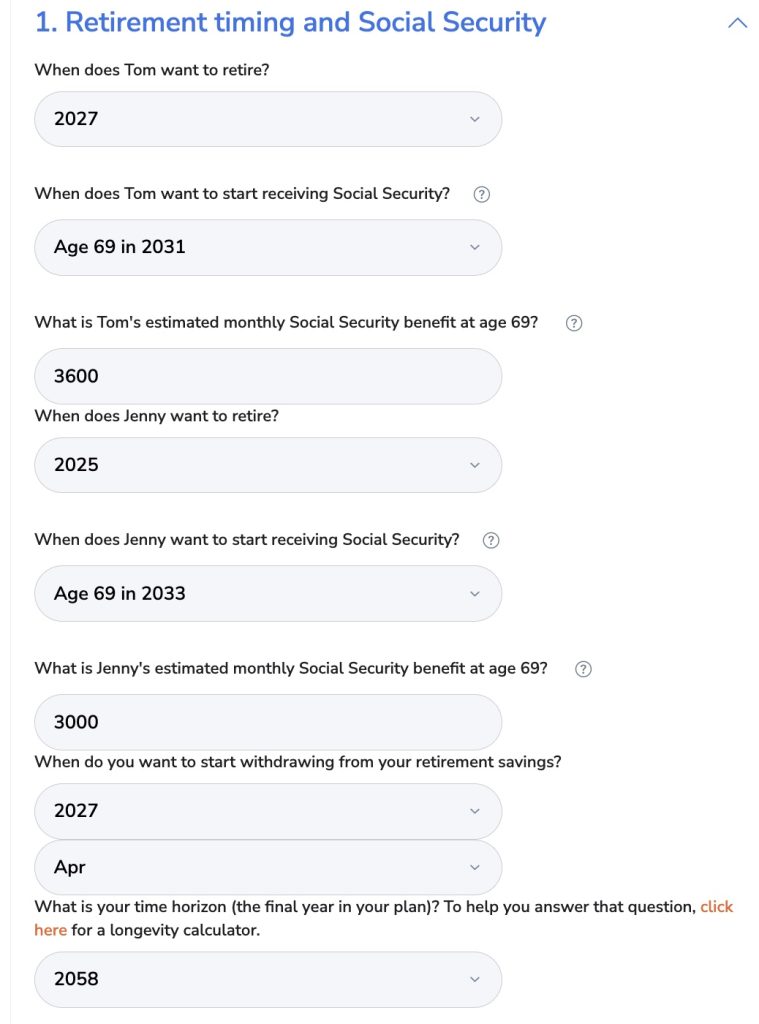
Start by telling The Best Third about your retirement timeline. When do you plan to retire? When will you — and your spouse or partner, if applicable — begin claiming Social Security? What is your estimated monthly benefit at that age?
Social Security claiming age has a significant effect on your plan. Claiming at 70 rather than 62 can increase your monthly benefit by 75% or more, which directly reduces how much your portfolio needs to cover each year. The tool lets you compare different claiming scenarios side by side.
You’ll also set your time horizon — the final year of your plan. Rather than assuming a fixed 30-year retirement, The Best Third uses actuarial data to help you choose a horizon that reflects realistic longevity. This matters because a plan built to last to age 88 looks meaningfully different from one built to last to age 95.
Get Your Personalized Plan
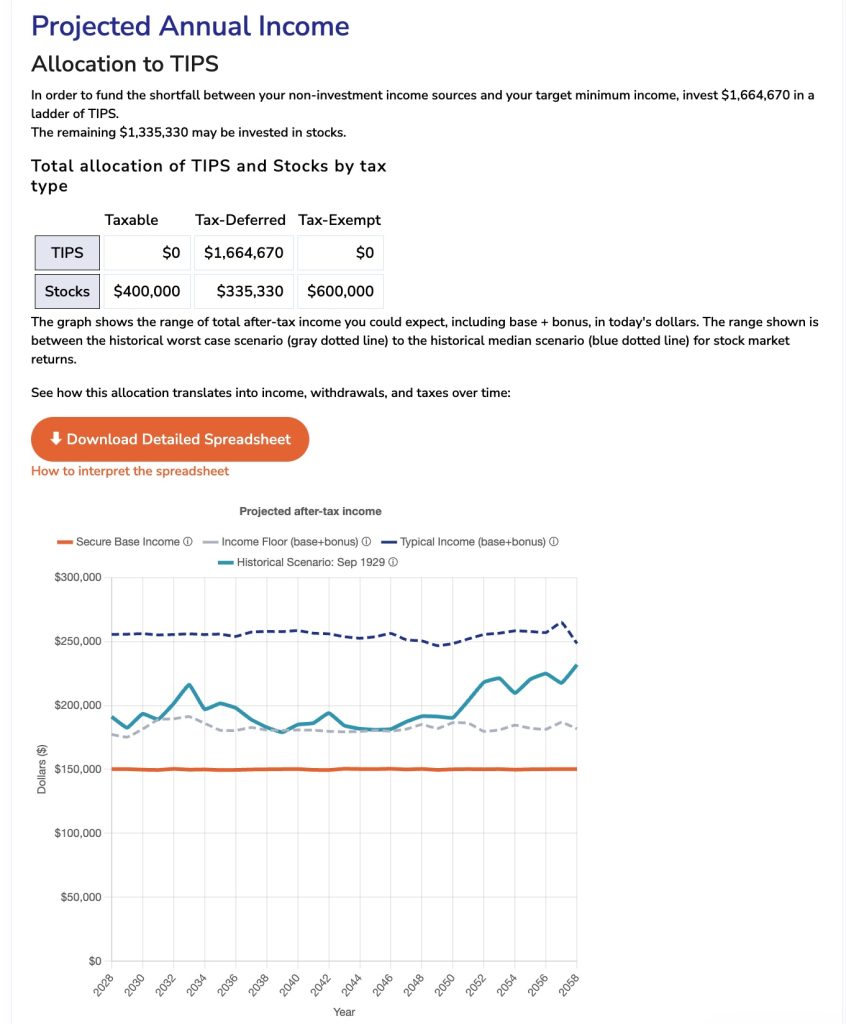
Your plan shows two income streams side by side: your Secure Base Income — the fixed, inflation-adjusted amount covered by TIPS and Social Security — and your variable Bonus Income from the equity portfolio, recalculated each year using ARVA.
You can test how your plan would have performed if you had retired at the start of some of history’s most challenging market environments — the Great Depression, the dot-com crash, the 2008 financial crisis. This isn’t a Monte Carlo simulation producing a probability range. It’s your actual plan, applied to actual historical market returns, showing you what you would have spent in each year of those scenarios.
You can also adjust retirement dates, Social Security claiming ages, spending targets, planning horizons, and how much income you want to secure, to see how each decision affects your income. The result is a plan you can interrogate, not just accept.
The Research Behind the Method
The methodology underlying The Best Third is published in the Financial Analysts Journal — one of the most rigorous peer-reviewed publications in finance. The article has become one of the most-read in the journal’s history and is available open access: no subscription required.
The math is fully documented, peer-reviewed, and explainable. If you want to understand exactly how the calculations work, read it in full.
Build Your Personalized Retirement Income Plan
The same rigor you applied to saving, now applied to spending.